
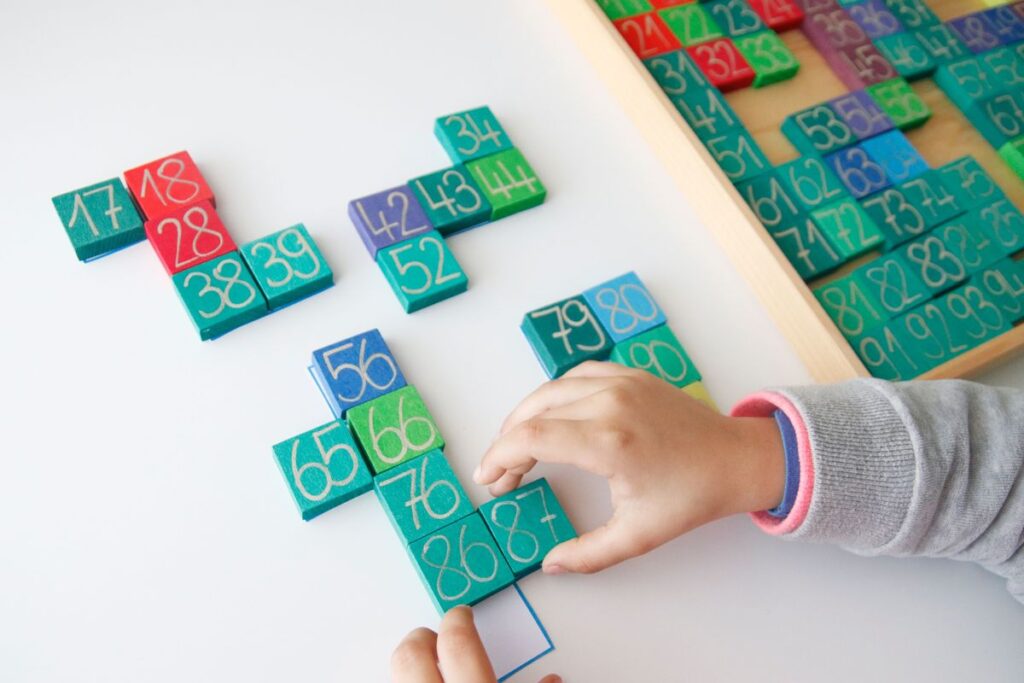
Without a doubt in the first grades of primary school we start with multiplication tables, It is one of the most remembered memorization processes of childhood. like everything, There are tables that are easier than others, and children who have a more complicated learning process than others.
Let's get to work on finding some strategies to make learning multiplication tables more effective..
Trick 1: DO NOT memorize
Definitely force a child to learn the tables in order or disorder, from top to bottom, etc… It means learning something that is not understood.. If the child has the so-called “good memory” but, memory often has no words…what to do if memory fails?
Contrary to what we may think, tables can be reasoned and not so much memorized, That's why we recommend that you first learn the tables that cost the least, these are those of the: 1,2 y 5. Try it and you will see that they are the ones you remember most easily..
Trick 2: Before facing the terrible tables…what should be known?
Before thinking about multiplications, we must take into account that the child must master (if not perfectly) at least understand the sums. Through the addition, the child can find shortcuts to reach the result of a multiplication.
A tip to master addition is to start with single digit numbers., If you have already passed primary school and want to apply these tips to improve multiplication…Forward, It's NEVER too late!
Tjump 3: If addition is already mastered…What's next?
You can play to solve multiplications and additions avoiding the keyword “more” “for” corresponding to addition or multiplication respectively. For example:
Tu: how do you say 3 without saying 3?
Student: ¡2 y 1!
Tu: how do you say 7 without saying 7?
Student: ¡4 y 3!
Tu: and are you able to say 7 saying 5?
Student: ¡5 y 2!
The important thing about these dynamics is that the child can reason, understand and then learn multiplication tables using different resources.
 Trick 4: The transformation of multiplications
Definitely the simplest tables are the ones that are memorized the fastest., but what about the table 7 For example, it is the one we remember the least..
If you don't know the table 7 or that of 4 For example, we cannot resort to adding 7 times 4 in 4 times 7 in case you want to multiply 7 x 4.
So: we can take one of the two factors, and decompose it with some number of the best known tables, for example use 1, 2, o 5.
For example we are going to use the 2 as an ally: Para resolver 7x 4 what are they 28, decomposed with the table 2 I would be: 7×2 y 7×2 what is 14 y 14, what a sum it gives 28, exactly the same as 7×4.
Trick 5: You already “caught the wave” Then it's time to move on to the next table
If you already master the tables of 1, 2 y 5 you can decompose more multiplications, The problem is that decomposing too many times to reach a result is cumbersome..
The next challenge may be to learn the table of the 3 Although it is a little more complicated, it is less complicated than that of the 7 o 9, this being the way to reach 8×7.
There is no way or magic formula to learn the tables, there is only advice
The task of learning to multiply is certainly not quick and for many it is not easy., That is why other points must be taken into account to make this facet that will be used throughout life more bearable.:
- If you learn to multiply well, reasoning, It will be used for other calculations such as division between several figures, that is so feared.
- The student is not obliged to write the entire process by which he or she arrived at the result..
- It is better to arrive at the result by reasoning than by memorizing.
- The student is completely free to choose the path that is easiest for him to reach his result..
Remember that there is not only one way… the numbers are infinite.
Reference: Professor Bernal Beu